The Hound Hunt for HCE
Finnegans WakeThe Hound Hunt for HCE recounts an elaborate pursuit that ends not with capture but with the hunters’ return empty-handed. Hounds and beaters track Humphrey Chimpden Earwicker across a winding route, yet his ability to disappear, double back, and persist through a regimen of dietary restraint frustrates the chase. Its comic reversal is carried by the telling as much as by the action: the pursuit sprawls across place-names and verbal turns, while the quarry remains beyond the pack’s reach.
The Hunt Begins
The episode frames the pursuit as a threat to HCE’s future as well as his immediate safety. The narrator suggests that the ancestor has saved himself from a reckoning with posterity by playing possum. Meanwhile, gundogs of every breed are let loose with bugles, eager to run him down under the force of law. The chase is presented as an organized hunt, but its grand official purpose is already shadowed by the possibility that the quarry will evade it.
A Circuitous Route
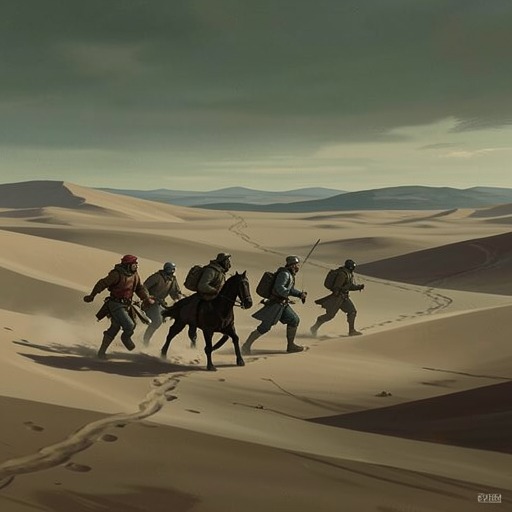
The run begins from HCE’s hiding place and sweeps across the Christmas countryside of Humfries Chase. From Mullinahob and Peacockstown the route turns toward Tankardstown, passes through Raystown and Horlockstown, then returns to Tankardstown. The hunters mistake a white animal for a bear before it leads the baying pack onward; later, HCE doubles through Cheeverstown, Loughlinstown, and Nutstown, with the hounds trying to bring him to ground by the Boolies. The place-names map a chase that circles and repeats rather than advancing cleanly toward an outcome.
Evasion and Its Means
The pursuit’s turning point comes when HCE is lost on the Hill of Rut in full winter dress. Pointing toward his lodging, he conceals himself in a covert, where the narrative describes him as miraculously sustained by a rich mixture of food and drink, including cinnamon syllabub. The hunters cannot establish a firm trail again. The paired phrases “Mikkelraved, Nikkelsaved” cast the escape as a saving reversal: the apparent quarry is preserved, and the pack’s momentum is broken.
HCE’s later rebuttal is not a counterattack against the hounds but a sustained effort to re-educate his intestines. He diets against rich gravies and other heavy foods in the old town, and this discipline gives him the advantage over his pursuers. Violence and denunciation are said to seek his downfall, yet their efforts fail to dislodge the powerful shipping and linen magnate. The account thus makes bodily regulation—not force—the practical means of his resistance.
Failure and Narrative Effect
The hounds ultimately head home, leaving the hunt unresolved in the hunters’ favor. The episode closes with the assembly murmuring that Reynard is slow, a final judgment that turns delay into the scene’s defining quality. HCE’s escape is a concrete failure of capture, but the circling route and the digressive, punning narration also make the reader experience pursuit as prolonged uncertainty. The hunt promises a decisive apprehension; instead, repeated turns, mistaken identification, concealment, and a change of diet carry the story away from that ending.